
by Mike Sheldon
 You probably wonder why Mepps® offers so many different lure colors. Who would use some of them? What possible reason could there be for making some of the colors we do? Most fishermen use a particular color because it has worked for them in the past. That's a pretty good reason, but it doesn't mean that color will always produce the best for you. There could be better colors staring you in the face, but you will not try them
 because they are not "proven" to you. This kind of thinking can have a very negative effect on your fishing success, and the whole idea is to catch more fish, right? Why do I say, "What you see is not what you get!"
 Everybody has worn sunglasses sometime in their life. Did you ever notice when you wear green glasses, things look different than they do when you wear glasses with amber or brown lenses? You were probably really surprised if you ever put on a pair of glasses with rose-colored lenses. It really changes the appearance of colors. Have you ever worn glasses with yellow lenses on a dark, cloudy day and seen how bright everything becomes? This happens because colored lenses filter the incoming light. For example, if an object appears red to your eyes, it's because light rays on the red end of the spectrum have hit that object, and are reflected back to your eyes. If there is no red light hitting the object, it cannot reflect red back to you.
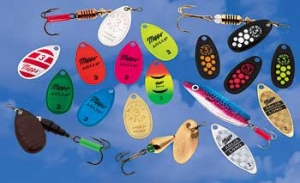 Lures viewed out of the water
Note how vivid these lure colors are when viewed out of the water. These bright colors change considerably when they are viewed under water.
Water acts as the "colored lenses" fish "wear." However, instead of being a thin glass lens, water is a thick liquid lens. The deeper the water or the farther a fish is from the object it is viewing, the stronger the filtering effect. There are three "lens" colors of water, blue, green and brownish-red. So when a fish is looking through the water, it is similar to wearing blue, green or brownish-red glasses.
Lures viewed in blue water
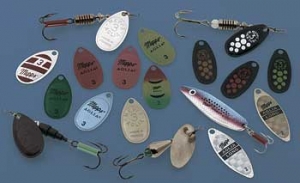 Blue water filters out red, so red lures become almost black and white in blue water. The red-and-white Aglia® blade is a good example of what happens to a red lure in blue water.
Let's use a red lure as an example. Red is the first color to be filtered by any water color. If I hold a Mepps red-and-white Aglia® in my hand, I distinctly see a red and white blade. If I jump into Lake Superior's blue water and swim down ten or fifteen feet, however, all of the red light rays are filtered out and the red turns black. My lure is now a black and white Aglia. When I return to the surface, it's red and white again.
Lures viewed in green water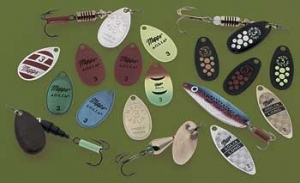 Green water filters out red so quickly, just below under the surface a red lure appears black and white. Again, the red-and-white Aglia® blade is a good example of what happens to a red lure in green water.
If I jump in one of our inland lakes with a summer algae growth coloring the water green, the green water becomes a much stronger filter and the red light is filtered out in just a few feet. Again, the lure appears black-and-white because the red light rays have all been filtered out. When I swim back to the surface I have a red-and-white lure again.
Lures viewed in Red water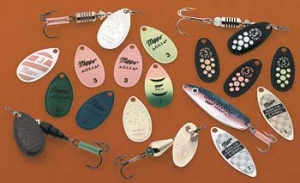 Stained (reddish/brown) water filters out red, so red lures lighten up considerably in stained water. Note how washed out the red-and-white Aglia® becomes in stained water.
It's strange what reddish brown water does. River water that drains out of swampy, boggy areas gets stained red from the tannic acid present in the water. Reservoirs that flood swampy areas can be the same. Most fishermen have seen and fished these "red" waters. Red water filters out red light rays quickly and completely, so the red-and-white blade on my Aglia quickly becomes a white blade.
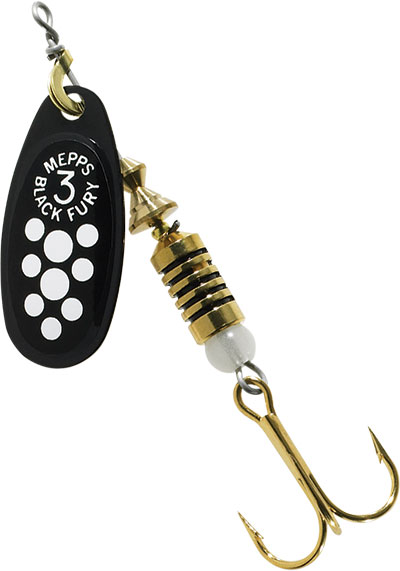 This is why contrast is so important when selecting a lure color. The pictures you see here do a good job of illustrating this. Notice, for example, how the contrasting dots of the fluorescent dot Black Fury® stand out. The yellow dot Black Fury, which is very bright to our eyes in normal daylight conditions, does not stand out in clear blue water or green-colored water, but it's outstanding in red water. Chartreuse is a terrific color in clear blue water, even at great depth. However, in green water, it is almost invisible.
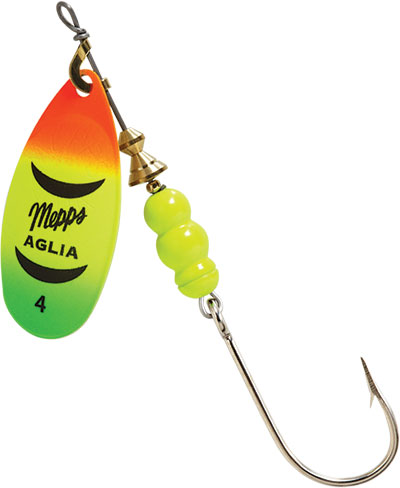 The photos also illustrate why hot firetiger is such a popular and useful color. At least one of this blade's colors is visible in any water color, so this lure can easily be seen by the fish under many different fishing conditions. Start paying attention to water conditions and colors next time you're fishing. Put some thought into your selection of lure color. What is the tint of the water... clear blue, green, reddish brown? Lower your lure to the bottom in shallow water. Do you notice any tint changes? How about brightness of the surrounding light? Is it bright sunny, or cloudy? If it's cloudy, is it still bright or a darker cloudy? What time of day? Early? Mid-day? Late?
Light affects the strength of the filtering effect of the water. In bright light, more light will transmit and it will transmit deeper. Low light will mean everything is dimmer and darker. Also, keep in mind your lure is in a colored haze. Visualize what color your lure needs to be to stand out in this colored fog.
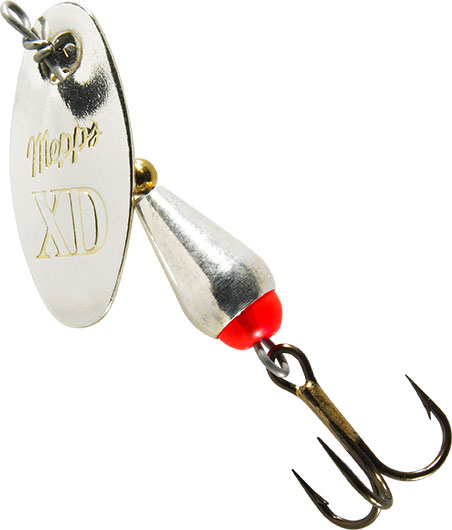 Many Mepps® lures, with their carefully selected blade, body and bead colors, provide optimum visibility under a wide variety of water conditions. This is Mepps® Color Technology. All of our XD spinners, for example, feature Mepps® Color Technology. The XD illustrated features a genuine silver plated blade and body for maximum flash and visibility.
The message, while it may seem confusing at first, is simple. Start paying more attention to water, light and lure colors, and begin catching more fish.